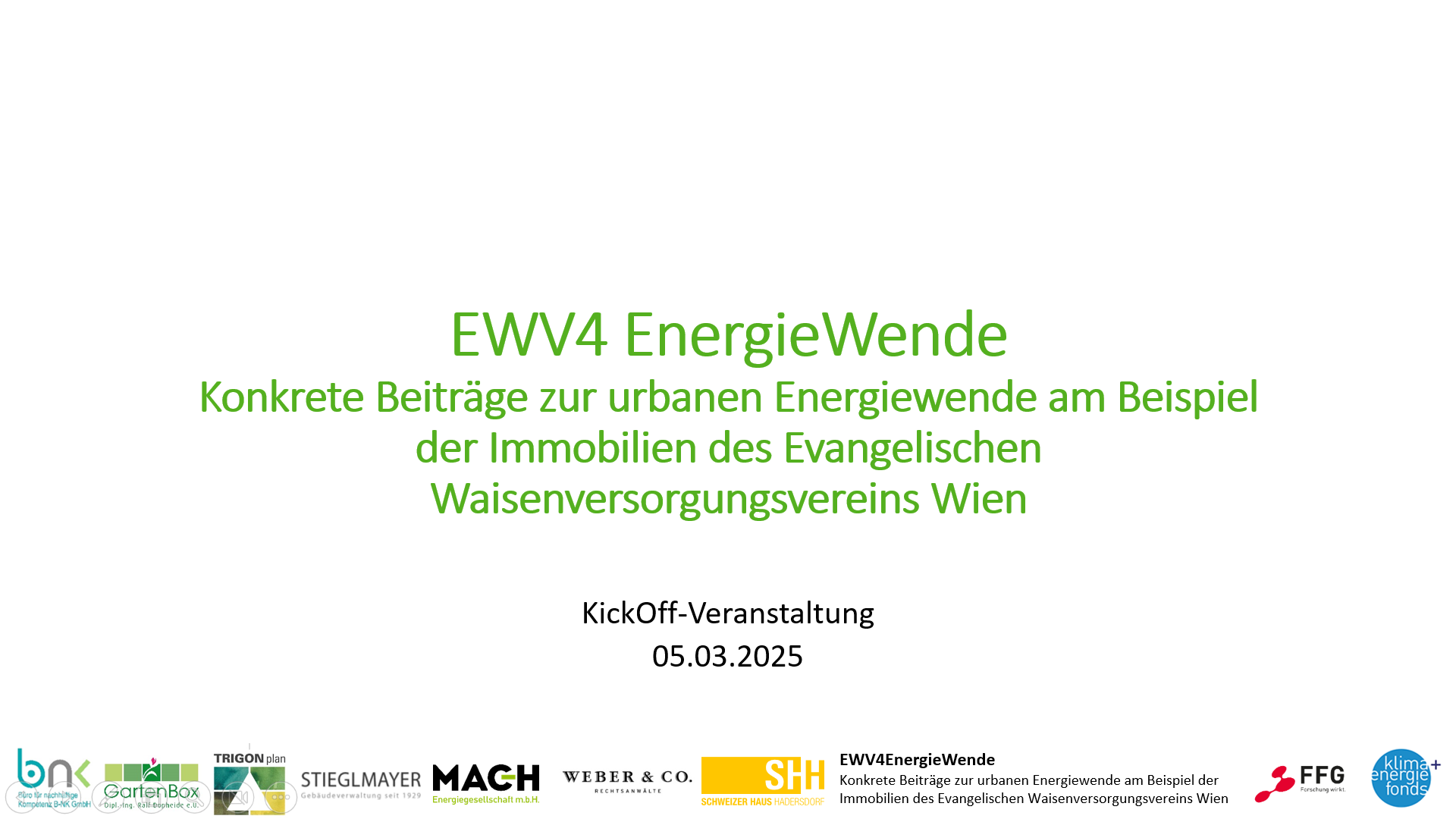


Concrete Contributions to the Urban Energy Transition: The Case of the Properties Owned by the Evangelical Orphan Care Association of Vienna
Climate change and the current energy crisis pose challenges for people. The expansion of renewable energy and renewable energy communities (EEG) is an approach to reducing reliance on fossil fuels while also increasing independence from fluctuating or rising energy prices. Since the Renewable Energy Expansion Act took effect in 2021, a large number of EEGs and citizen communities (BEGs) have been established in Austria. In densely built-up urban areas, establishing EEGs proves to be more complex due to regulatory, social, economic, and technical factors. These include, for example, conflicts of interest in multi-unit residential buildings or a lack of economic incentives. Furthermore, establishing and operating an EEG is often perceived as too complicated.
In this project, we aim to 1) identify these challenges in expanding renewable energy and implementing the Renewable Energy Act (EEG) in densely built-up urban areas and 2) offer solutions through a clear, inclusive, and gender-sensitive communication strategy. We aim to create innovative solutions for climate-neutral cities and city blocks, thereby contributing to the infrastructural, economic, and social transformation toward a more sustainable future.
As part of our project, we are collaborating with the Evangelical Orphan Care Association of Vienna (EWV)—which owns six properties in Vienna—to examine the feasibility of expanding renewable energy and establishing renewable energy communities (EEGs) in densely built-up urban areas, as well as the potential opportunities this presents. Based on an assessment of the current situation as well as technical and social potential analyses, we are gathering key insights for the implementation of renewable energy communities in densely built-up urban areas. These insights will be documented and can serve as a foundation for subsequent projects or studies. In conjunction with specific buildings and city blocks, co-creative lines of argument and incentive models will be developed to improve acceptance of technical and social solutions. At the end of the project, based on the analyses and economic comparative calculations, a phased implementation plan will be developed, including recommendations for how individual buildings and sites can address the energy transition, renewable energy, and renewable energy communities. This plan will outline both the benefits and the risk factors associated with the respective implementation recommendations.
The project will generate a knowledge base on the personal, organizational, and structural success factors and barriers that influence active participation in the energy and heating transition, as well as in acceptance of renewable energy communities. The results will offer valuable insights for other initiatives and could serve as a model for other property owners in urban areas to help advance the expansion of renewable energy and the creation or joining of RECs.